
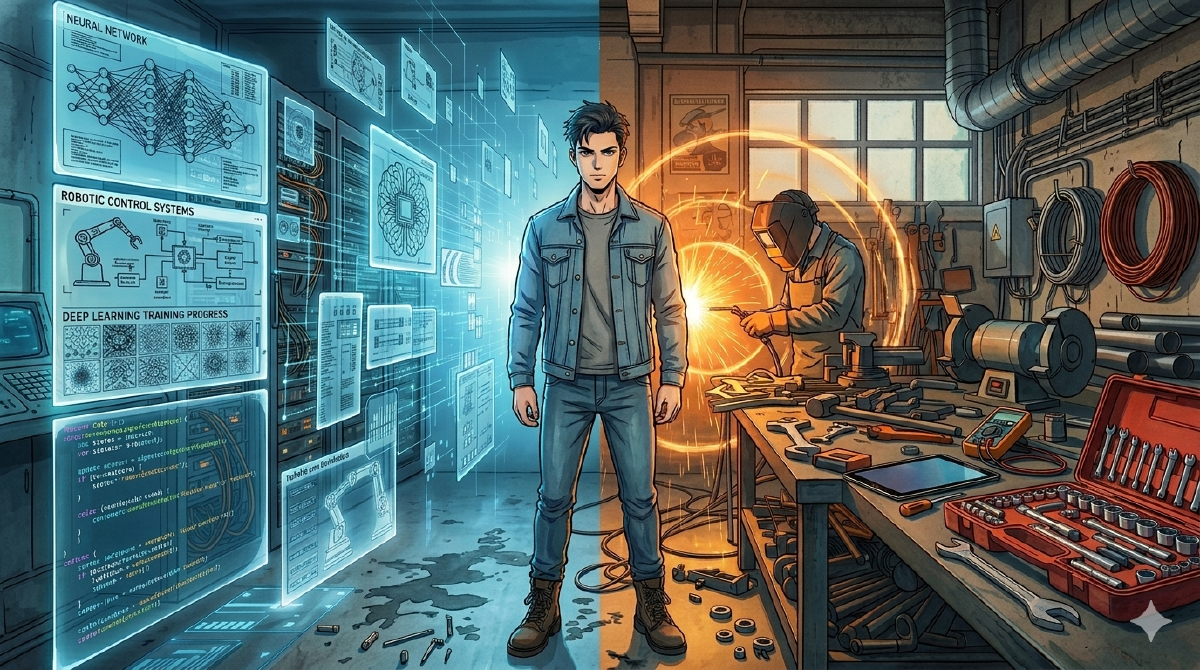

Gen Z’s Trades Revolution: How Young People Are Escaping AI Job Risk #
Jackson Curtis had 3½ years in insurance. Now he’s training to be a firefighter. Ryder Paredes dropped out of computer science to study electrical work. Across America, young people are fleeing white-collar careers for trades—and the data shows it’s not just panic, it’s pragmatism.
Meet the New Resistors: Young People Choosing Wrenches Over Keyboards #
Jackson Curtis, 28, spent three and a half years in insurance, mostly doing data entry. He’s now pursuing a completely different path: becoming a full-time firefighter.
Ryder Paredes, 22, began studying computer science three years ago when “AI was in its infancy, it wasn’t very intelligent.” By last year, he feared he wouldn’t be employable. He dropped out and enrolled in trade school to become an electrician.
Thea Babith, 17, changed her college plans from finance to international relations because her mother compiled a career guide showing which fields AI couldn’t replicate. Diplomacy, with its emphasis on “genuine human talking,” felt safer.
These aren’t isolated anecdotes. They’re the human faces of a seismic shift that’s reshaping America’s career landscape in 2026.
The Numbers Don’t Lie: Vocational Enrollment Is Booming #
While traditional college enrollment has dropped by 2 million students since 2011, vocational and trade schools are experiencing explosive growth:
- Public two-year vocational enrollment grew 13.6% in Fall 2024—the second consecutive year of double-digit growth
- Trade school enrollment increased 4.9% from 2020 to 2023 and continues accelerating
- In the first quarter of 2024, Gen Z made up 18% of the workforce—but 18- to 25-year-olds accounted for nearly 25% of all new hires in skilled trade industries
- The global technical and vocational education market is projected to grow at 10% CAGR through 2030, reaching $1.4 trillion
Most telling: vocational programs are now “well above their enrollment levels in 2019.” The stigma is fading, and fast.
The “Dinner Table Anxiety” Epidemic #
“It’s been a lot of dinner table anxiety,” says Babith Bhoopalan, former Microsoft product manager turned consultant. He compiled a detailed career guide analyzing which professional roles AI couldn’t replicate—doctors and diplomats made the safe list, finance did not. He shared it online; 5,500+ people have viewed it.
Stacie Gleason, a high school counselor in Hoboken, N.J., says she has daily conversations with seniors wondering how AI might affect them. “Students definitely know it’s going to have an impact,” she says. “It’s just not clear how much of one or what it looks like.”
A Harvard survey of Americans ages 18-29 showed 59% see AI as a threat to their job prospects. Among college graduates, the number is even higher. 41% think AI will make work less meaningful.
When your parents are having anxiety attacks about your career prospects before you’ve even started, something has shifted culturally.
The AI Paradox: The Technology Destroying Jobs Is Also Creating Trades Demand #
Here’s the twist nobody saw coming: The AI boom itself is fueling demand for skilled trades.
A Randstad report (March 2026) reveals that Big Tech companies culling office workers are simultaneously facing hundreds of thousands of vacancies in roles needed to build and maintain data centers:
- Data center electricians (wiring substations, installing backup power systems)
- HVAC technicians (cooling server farms that consume megawatts of power)
- Industrial technicians (maintaining specialized equipment)
- Construction workers (building massive facilities)
Mike Rowe (host of Dirty Jobs) recently highlighted that he’s met data center electricians making $280,000 per year. That’s not a typo. The AI infrastructure requires a physical backbone that algorithms can’t install themselves.
“When AI can wire a substation, plumb a data-center coolant loop, or install a server rack, then we’ll talk,” as one industry insider put it.
Why Trades Are AI-Resistant (For Now) #
The jobs seeing the least AI disruption aren’t random. They share common characteristics:
1. Physical Work in Unstructured Environments #
AI excels at pattern recognition and digital tasks. It can’t yet:
- Diagnose a misfire in a 20-year-old boiler
- Locate a pipe leak behind a finished wall
- Repair a commercial HVAC system during a July heatwave
- Climb into an attic and rewire a house
The physical manipulation of tools in unpredictable real-world conditions remains a human domain.
2. High-Stakes Human Interaction #
Firefighters, plumbers responding to flooded homes, electricians explaining complex issues to non-technical customers—these involve empathy, trust, and crisis management that current AI can’t replicate convincingly.
As Jackson Curtis noted: “Even if they can come up with a way to utilize AI to fight fires, people are always going to want that empathy from an actual human who actually cares during a moment of crisis.”
3. Licensing, Liability, and Regulation #
Many trades require state licenses, bonding, and insurance. Companies can’t easily deploy unlicensed AI systems for work that carries liability if done incorrectly. A bot that mis-wires a house could burn it down; that risk requires a human with legal responsibility.
4. Custom Problem-Solving #
Every construction site, every house, every commercial building is different. AI trained on historical data can’t easily handle the infinite edge cases that experienced tradespeople navigate daily.
The Salary Reality: Trades Can Out-Earn College Graduates #
Let’s talk numbers, because this is where the economic calculus gets interesting:
| Profession | Median Annual Salary | Top Tier Potential |
|---|---|---|
| Electrician (BLS) | $62,350 | $100k-150k+ (union/datacenter) |
| Plumber (BLS) | $62,970 | $80k-120k+ (commercial) |
| Construction Worker | $46,050 | $70k-90k+ (skilled foreman) |
| HVAC Technician | $55,000-75,000 | $90k-130k (specialized) |
| College Graduate (all fields) | $80,000 | Varies widely |
| Data Center Electrician | $150k-280k | $280k+ (overtime, specialized) |
Key point: The average starting salary for skilled trades is about $23/hour or ~$48k/year. But the top-tier roles—particularly in data centers, large commercial projects, or union positions with overtime—can exceed $280,000.
Meanwhile, many college graduates enter fields where starting salaries plateau in the $50-60k range, with student debt averaging $30,000-40,000.
Four years of college + debt vs. 9-12 months of trade school + immediate employment + no debt. The math is compelling.
Real People, Real Pivots #
Let me introduce you to some of the young people rewriting their career scripts:
Morgan Bradbury, 21 — Welder #
Tried welding in high school and was “mesmerized by the fact that I could have the ability to build things with my own hands.” She enrolled in a 9-month certification course costing $21,000. Before even completing the program, she landed a job at BAE Systems (military and information security) working on U.S. Navy ships with a starting salary of $57,000. She’s now a second-class welder.
Chase Gallagher, 24 — Landscaping Business Owner #
Started landscaping at age 12-13. Registered his company, CMG Landscaping, at 18. Looked at the numbers and decided: “I’m not going to go stop my business and pay for college.” In 2024, his business did $1,085,000 in sales. He earned just under $500,000 in salary + owner’s share.
Ryder Paredes, 22 — Electrician in Training #
Former computer science student who watched AI capabilities improve dramatically in just three years. “At first I was in denial,” he admits. “But eventually I had to just face it.” He dropped out and enrolled in trade school. He isn’t alone: vocational school enrollment has boomed nearly 20% since 2020.
The Data Doesn’t Lie: Junior Jobs Are Disappearing #
The career pivot isn’t just about seeking opportunity—it’s also about escaping vulnerability.
From earlier research (Anthropic, LinkedIn, layoff data):
- Junior and entry-level positions accounted for 38% of tech layoffs in 2024-2025, despite representing only 22% of the workforce
- Entry-level software roles dropped 31% (Q1 2024 to Q3 2025)
- Employment for workers aged 22-25 in AI-exposed occupations declined 16% relative to less-exposed roles (Stanford, 2022-2025)
- 61% of hiring managers at mid-size companies report receiving applications from candidates with 4+ years of experience for entry-level roles
If you’re a new graduate, you’re not just competing against peers. You’re competing against laid-off professionals with 3-6 years of experience now willing to take salary cuts.
This creates a perfect storm: the traditional entry path is narrowing, while the alternative (trades, entrepreneurship) is becoming more visible and lucrative.
Why Parents Are Panicking (and What They’re Doing About It) #
“Dinner table anxiety” is real. Parents who assumed a college degree guaranteed their child’s future are now questioning everything.
Some are taking action:
- Babith Bhoopalan (ex-Microsoft) created a viral career guide analyzing which fields are AI-resistant, now viewed by 5,500+ people
- High school counselors report daily conversations with seniors terrified about AI
- More families are visiting trade schools, speaking with industry instructors, reviewing labor-market data—the same due diligence once reserved for college selection
The message is spreading: A bachelor’s degree is not the only valuable path—technical and vocational training offers a different route to meaningful employment.
The Skills That Matter in the AI Economy #
If trades aren’t your thing, there are still white-collar paths that remain viable:
AI-Augmented Roles #
Every industry needs people who understand both the domain and AI tooling:
- AI Operations Coordinator
- Prompt Engineer (real ones, not LinkedIn influencers)
- AI QA Specialist
- Model Evaluator
- RLHF Trainer
These roles are new, poorly labeled, and hiring now.
Physical-Hybrid Jobs #
- Drone technician (inspections, repairs)
- Renewable energy installer (solar, wind)
- EV mechanic (electric vehicles require new skills)
- Robotics maintenance technician
All involve AI-driven systems but require hands-on physical work.
Judgment-Heavy Professions #
- Healthcare (doctors, nurses, surgeons)
- Skilled diplomacy/negotiation
- Complex sales (entire accounts, not scripted calls)
- Trades that require licensing and liability
The common thread: high-context human judgment + accountability + physical reality.
Should You Consider the Trades? A Framework #
If you’re a student, parent, or career-changer weighing options, consider:
Trade School Path #
- Cost: $4,000-25,000 (vs. $40k-150k+ for college)
- Time: 9-18 months to certificate/associate (vs. 4 years)
- Debt: Often $0-$15k (vs. $30k-60k average)
- First-year earnings: $40k-65k (with potential to double in 5-10 years)
- AI exposure: Very low—physical, unpredictable environments
- Career progression: Journeyman → Master → Business owner
College Path (Traditional) #
- Cost: $100k-250k total
- Time: 4+ years
- Debt: $30k-80k average
- First-year earnings: $50k-75k (varies wildly by field)
- AI exposure: High if in entry-level knowledge work
- Risk: Degree may be less valuable by graduation
College Path (AI-Strategic) #
- Fields: Nursing, skilled trades management, engineering (hardware), diplomacy/IR
- Strategy: Use AI tools to augment learning, build portfolio with quantifiable outcomes
- Supplement: Minor in data science/AI literacy regardless of major
- Goal: Become the person who uses AI, not the person replaced by it
The People Succeeding Right Now: What They’re Doing Differently #
Based on current data, here are the patterns:
- Choosing hands-on mastery over abstract knowledge
- Starting income-generating work immediately (apprenticeships, certifications) vs. accumulating debt
- Targeting the AI infrastructure (building/maintaining the systems) rather than the jobs AI replaces
- Building tangible portfolios (photos of work, certifications, client testimonials) vs. generic resumes
- Understanding the business—many tradespeople become business owners within 5-10 years
What About the Future? Will AI Eventually Replace Trades Too? #
Anything’s possible. But there are fundamental constraints:
- Physical embodiment: Humanoid robots are still laboratory curiosities. Building a robot that can replace a plumber in 95% of real-world scenarios requires breakthroughs in dexterity, safety, and cost that are likely 10-20 years away (if they arrive at all).
- Liability and regulation: You can’t deploy an unlicensed AI to rewire a house. Someone must carry the insurance and legal responsibility.
- Structured environments vs. chaos: AI thrives in predictable settings. Trades happen in literal chaos—old buildings, weather, unexpected failures.
That said, AI tools will augment trades:
- AR glasses that highlight wiring diagrams
- AI-assisted diagnostic tools for HVAC
- Project management and quoting automation
- Materials optimization and waste reduction
The tradesperson of 2030 will likely use AI daily—but as a tool, not a replacement.
The Bottom Line: Pragmatism Over Prestige #
The Great Trade School Exodus isn’t a rejection of education. It’s a rejection of credential inflation and embrace of outcomes over pedigree.
Young people are calculating:
- College degree → uncertain white-collar job → AI vulnerability
- Trade certificate → immediate employment → high demand → high income → entrepreneurship potential
They’re voting with their enrollment forms, and the message is clear: Show me the tangible results, or I’ll go elsewhere.
For parents: It’s time to expand the definition of “good career.” Your kid making $120k as an electrician at age 26 with no debt and a thriving business they own is winning—even if they didn’t follow the four-year-degree path.
For educators: The college-for-everyone model is breaking. Integrate trade pathways into high schools. Show real data on job placement, not just university acceptance rates.
For the economy: This could be the best thing that ever happened to America’s infrastructure. 130,000+ electricians, plumbers, and HVAC technicians are currently needed according to industry reports. The AI revolution might inadvertently rebuild the middle class—through the trades.
Action Items (If You’re Considering This Path) #
For Students #
- Visit a trade school this month. Talk to current students and instructors
- Shadow a professional in a field that interests you for a day
- Calculate the ROI: Trade school cost ÷ starting salary vs. college cost ÷ first-year salary
- Apply for apprenticeships (earn while you learn)
For Parents #
- Don’t dismiss trades as “plan B” — research actual salaries and demand
- Support your child’s interest even if it doesn’t match your vision
- Discuss business ownership potential: many tradespeople become employers within a decade
- Connect with families who have children in successful trades careers
For Career Changers #
- Identify your current skills that transfer (project management, customer service, physical stamina)
- Research local union apprenticeships (often free, with wages from day one)
- Network on LinkedIn with professionals in your target trade
- Try a “day in the life” simulation before committing fully
References & Data Sources #
- Randstad Report (March 2026): Skilled trades demand driven by data center construction
- National Student Clearinghouse: Vocational enrollment +13.6% Fall 2024
- CNBC Make It: Gen Z workforce data, salary benchmarks
- U.S. Bureau of Labor Statistics: Median wages by trade
- Fortune: Data center electricians earning $280k
- Anthropic Economic Research (March 2026): AI exposure by occupation
- Stanford Study (2022-2025): Employment trends for 22-25 year olds in AI-exposed fields
- Harvard Youth Survey: 59% of 18-29 year olds view AI as job threat
The career ladder has changed. The people who thrive won’t be the ones who cling to the old path—they’ll be the ones who recognize the new one when they see it. Sometimes that means wearing a suit. Sometimes it means wearing a tool belt.